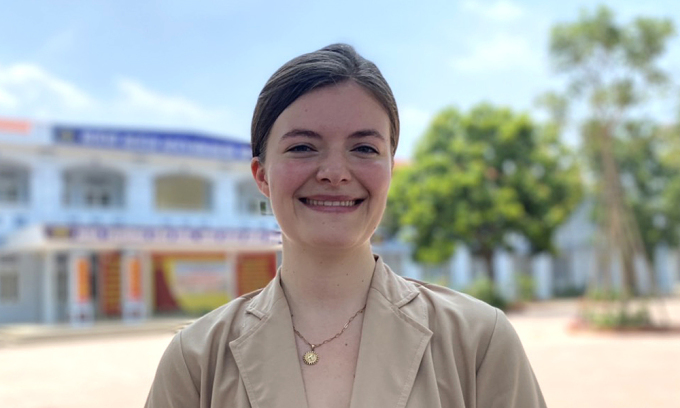
Two U.S. Peace Corps volunteers enjoy the ups and downs of teaching English to high school students in Hanoi.
Twenty-four-year-olds Kayla Kirby and Taran Anderson, along with seven other volunteers from the Peace Corps, have been working alongside Vietnamese teachers to bring English lessons to students at nine public Hanoi high schools since October last year.

Following a 10-week training period, Kayla has been teaching at a high school in Ba Vi District since January. An alumnus of the University of California, Santa Barbara, was given a room to stay at a local school, and she has enjoyed taking part in Vietnamese culture. She especially likes doing her shopping at local markets.
Kayla said she was surprised by how warmly she’s been welcomed by everyone: teachers, students and Vietnamese people in general. After five months, Kayla can now speak simple Vietnamese sentences and cook basic Vietnamese staples. Her favorite foods include pho, bun cha (rice vermicelli with roasted pork) and hotpot.
"People no longer think of me as strange. Now every time they see me, they say hello," she said.
Kayla is in charge of teaching English to three 10th grade classes, and she clocks a total of 13 lessons a week. But even after all the weeks of preparation, she said she couldn't help but feel nervous when she began her first class. She was worried the students wouldn't understand what she was saying.
But instead, the students in her very first class were welcoming and curious. They asked her many questions to get to know her, and thanks to the support from Vietnamese teachers, Kayla was able to interact with the students.
As for Taran, his first classes at a high school in Thach That District were unforgettable.
He teaches 10th and 11th graders 16 lessons a week. But despite the help of Google Translate, the language barrier has sometimes caused misunderstandings.
For example, when Taran once taught the word "superstructure" to his class, he defined it as a giant structure or building. But in trying to help students understand the idea, the Vietnamese teacher accompanying him began explaining the word as it pertains to Marxist theory. Taran said he’s been through several moments when neither his teaching partner nor the students knew what he was talking about.
And all this comes even after Taran had already taught English to children in 10 other countries.
While their Vietnamese teaching partners are in charge of teaching the students grammar, Kayla and Taran would focus more on vocabulary and pronunciation.
Kayla said pronunciation is what comes most difficult to most of her Vietnamese students. The most common mistake is not pronouncing the last syllables of English words properly. So Kayla said she tries to pronounce and repeat words slowly before asking her students to repeat them. A kind of repetitive call and response like this often works as it helps train students’ muscle memory.
When some students are too shy to speak, Taran speaks Vietnamese with them to help them overcome their anxiety of speaking English.